In today’s hyperconnected digital landscape, threats evolve faster than ever. From ransomware attacks to insider threats and supply chain compromises, organizations face an ever-growing list of potential risks. Traditional reactive security models are no longer sufficient. The future of cybersecurity lies in Predictive Analytics—using artificial intelligence (AI) to shift from detecting threats after they occur to predicting potential threats before they materialize.
Enter AI-Driven threat prediction, a transformative approach that leverages machine learning, behavioral analytics, and compliance frameworks to anticipate risks and strengthen organizational resilience.
The shift from Reactive to Proactive with Predictive
Modern AI-powered threat detection systems operate on multiple levels, creating a comprehensive security ecosystem that continuously monitors, analyzes, and predicts potential threats.
For years, cybersecurity teams have relied on threat detection tools like SIEMs (Security Information and Event Management), firewalls, and endpoint protection to identify malicious activity. While effective, these systems often operate in a reactive mode – alerting only after an anomaly or breach has occurred.
But what if we could predict threats before they strike?
This is where predictive analytics comes in. Predictive analytics in cybersecurity leverages machine learning algorithms, and pattern recognition to identify potential security risks before they become active threats. By analyzing vast amounts of historical data, network traffic patterns, user behaviors, and system anomalies, AI systems can forecast potential attack vectors with remarkable accuracy. The predictive analytics on threats enables proactive approach to counter the potential threat and impact.
The shift from "detect and respond" to "predict and prevent" represents a fundamental transformation in how we approach proactively on digital security. At the forefront of this evolution is artificial intelligence, which is revolutionizing threat prediction and enabling organizations to stay ahead of cybercriminals.
What Cavirin brings on the table? An AI-driven Predictive Approach
Threats can be identified through behavior analytics, traps, anomalies, monitoring, and penetration testing. Usually, the response to identified threats is reactive. However, the current cyber environment requires a proactive strategy to detect potential threats and plan countermeasures. This need motivates cyber experts to create intelligence-driven threat intelligence modules. Integrating posture management with threat intelligence, enables cybersecurity experts to tackle potential threats proactively.
The Cavirin Platform produces extensive posture management data by continuously discovering and assessing cloud and on-premises resources using various benchmarks. AI models then process the data to predict potential threats within a hybrid environment. This approach uses benchmark-defined policies, posture scores, and frequent scans to forecast threats associated with policy failures.
The Cavirin Platform can provide a strong base to build intelligence in Threat Prediction with AI to achieve new heights in the cybersecurity world. The data analytics of Cavirin feeds the AI model and results in the potential threats that may impact the cloud, on-prem, or hybrid environment.
How it works?
Pattern Recognition: Given the high volume of security and compliance assessment data—resulting in pass/fail outcomes across various policies—distinct patterns often emerge. Cavirin’s AI engine is designed to process this data in parallel, identifying subtle patterns that may signal underlying vulnerabilities or emerging threats. With built-in predictive analytics, the platform proactively forecasts potential risks and their likely impact if left unaddressed. Unlike traditional rule-based systems that depend on known threat signatures, Cavirin AI leverages behavioral analysis to detect previously unknown attack vectors by recognizing deviations from established baselines.
Environmental Risk Scoring: Cavirin AI evaluates an organization’s digital environment against known attack vectors, assigning risk scores to systems, cloud resources, misconfigurations, configuration gaps from the standard benchmarks. The risk score has been determined from the policy failures with criticality and severity factors.
Predictive Modeling: Using historical data, AI forecasts where and when the attacks are most likely to occur, possible threats corresponding the policy failures observed in assessment against the standards like CIS, NIST, SOC2, PCI, HIPAA, ISO, etc. The policy failures across the digital footprint, create data points for the platform to determine threat factors and possible impact.

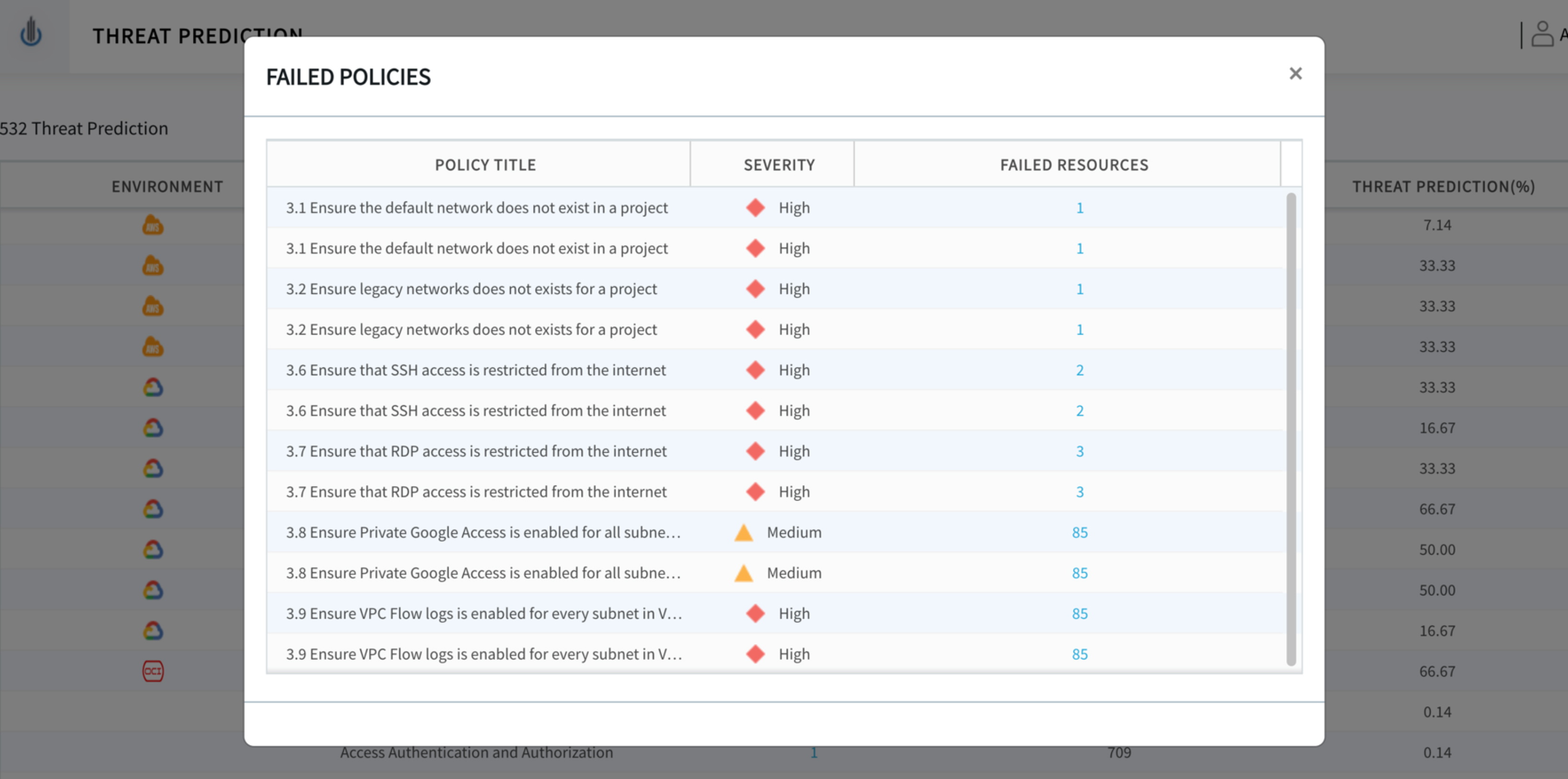
Fig – 1 above shows the policy failures while assessed against standard benchmark, which leads to Fig – 2, showing the number resources observed with the policy failures, pointing the potential threats.
The predictive analytics not only determines the potential threats but also empowers the security teams to take remediation actions and continue the best security practices.
Real-World Applications and Benefits
Organizations implementing AI-powered threat prediction are seeing significant improvements in their security posture:
Proactive Security Management: The predictive analytics in the platform identify the possible security breaches, where the vulnerabilities are most likely to emerge based on system misconfigurations, deviations and historical data patterns.
Advanced Persistent Threat Detection: Long-term attack campaigns that might evade traditional detection systems can be predicted and identified through AI analysis of subtle, seemingly unrelated activities over extended periods.
Insider Threat Prevention: By establishing baselines and monitoring for deviations, AI systems can predict potential insider threats before malicious actions occur.
Best Practices for Implementation
Organizations looking to implement AI-powered threat prediction should consider these best practices:
Start with Clear Objectives: Define specific use cases and success metrics before implementing predictive analytics solutions.
Ensure Data Governance: Establish robust data collection, storage, and processing procedures that comply with relevant privacy regulations.
Integrate with Existing Frameworks: Align AI initiatives with established security frameworks like CIS Controls, NIST, SOC 2, ISO, etc.
Invest in Training: Develop internal capabilities for managing and interpreting AI-generated insights.
The Future of Predictive Cybersecurity
As AI technology continues to evolve, we can expect even more sophisticated threat prediction capabilities. Emerging technologies like quantum computing, advanced neural networks, and federated learning will further enhance our ability to predict and prevent cyber threats.
The integration of AI with established security frameworks represents a paradigm shift in cybersecurity. Organizations that embrace predictive analytics and AI-powered threat detection will be better positioned to protect their digital assets, maintain compliance with security standards, and respond effectively to the ever-changing threat landscape.
The future of cybersecurity is predictive, proactive, and powered by artificial intelligence. By leveraging these capabilities within proven frameworks like CIS, NIST, SOC 2, NIST, etc., organizations can build resilient security postures that anticipate and neutralize threats before they become reality.
Ready to transform your organization's cybersecurity approach with AI-powered threat prediction? Contact our team of experts to learn how predictive analytics can enhance your security posture while maintaining compliance with industry standards and frameworks.
Written by :
Amarnath Bhadrashetty (Sr. Director, Product Management and CX).
Rakesh Polepeddi (Sr. Dev Lead).